
By Charlene N. Rivera-Bonet | Waisman Science Writer
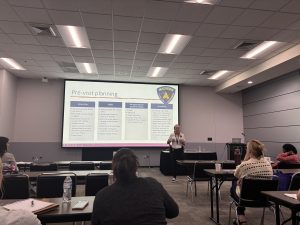
Every year, the Collaborative Stabilization Coalition (CSC) of Greater Dane County gathers care providers of adults with intellectual and developmental disabilities or dementia for the Crisis Prevention Summit, a space to learn about how to help prevent or respond to a crisis. This year’s summit took place on March 23 at the Alliant Energy Center.
As a member of the CSC, the Waisman Center’s Community Outreach Wisconsin’s (COW) director of community outreach, Michael Truman, helped spearhead the event along with CSC co-leaders Angela Radloff and Beth Freeman. They were supported by a planning team.
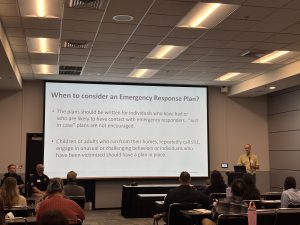
The morning of the summit started with an interactive, motivating, and informative keynote talk by Alonzo Kelly, PhD, on the topic of Navigating the Terrain of Change. Attendees then had choices of breakout sessions, each designed to help better understand factors that can contribute to behavioral health crisis for adults with intellectual and developmental disabilities or dementia, present resources available to help prevent or respond to a crisis, and strategies for effective communication and planning.
Crisis is defined by the CSC as an acute episode or a series of events that destabilizes a person to the point they may be viewed, or are considered to be, unsafe to themselves or others, and as a result, is at risk of being removed from their home to a more restrictive environment.
“People working within the system really have to know what resources are available, which ways to respond work best, and who does what within the system,” says Theresa Fishler, a retired social worker involved in the planning of the summit. “I think to best support individuals, the more information and education we have about what crisis is, how it impacts people, and what we can do to prevent it or deal with it safely and move on, is integral to person-centered support.”
The summit offered a wide range of topics centered around crisis prevention and stabilization including personal safety during home visits, tools and tips for transitions, humanizing crisis prevention, who to call when a crisis happens, music and dementia, maintaining safety along the dementia continuum, among others.
Each topic was selected to help bridge gaps in knowledge, needs, or resources so that people can get help quicker and more efficiently, says Katie Burt, a program manager with an IRIS (Include, Respect, I Self-Direct) consulting agency who sits on the organizing committee of the summit.
Waisman’s role in crisis prevention
The Waisman Center’s Community Outreach Wisconsin has a team of behavior specialists that work directly with individuals with intellectual and developmental disabilities and their support teams. “Our behavior specialists are regularly working with individuals. But then when crises arise with those individuals, then our behavior consultants are pulled in to help even more to deal with the crisis situation that the person is dealing with,” Truman explains.
COW’s program Community TIES is also involved in a collaborative effort called Crisis Response, a coordinated, community-based approached to crisis prevention and response for Dane County adults with intellectual and developmental disabilities experiencing acute behavioral health crises. Their interventions strive to enhance the safety of individuals and their caregivers and to prevent or shorten institutional admissions or incarcerations.
In addition to this, through a collaborative arrangement with Dane County Human Services and Journey Mental Health, Community TIES has been offering Crisis Stabilization Services, a voluntary, consent-driven, and short-term program designed to help an individual with an intellectual and developmental disability experiencing a mental health or behavioral crisis and their care or support team get back to a stable place. COW’s outreach program director Axel Junker, alongside Dave Verban, the Crisis Stabilization Services provider, presented this initiative at the Crisis Prevention Summit.
The summit brought people together to learn from each other, build capacity, and spread awareness of the programs and resources available for crisis prevention to help them provide the best support they can to the individuals with dementia or intellectual disabilities they care for.